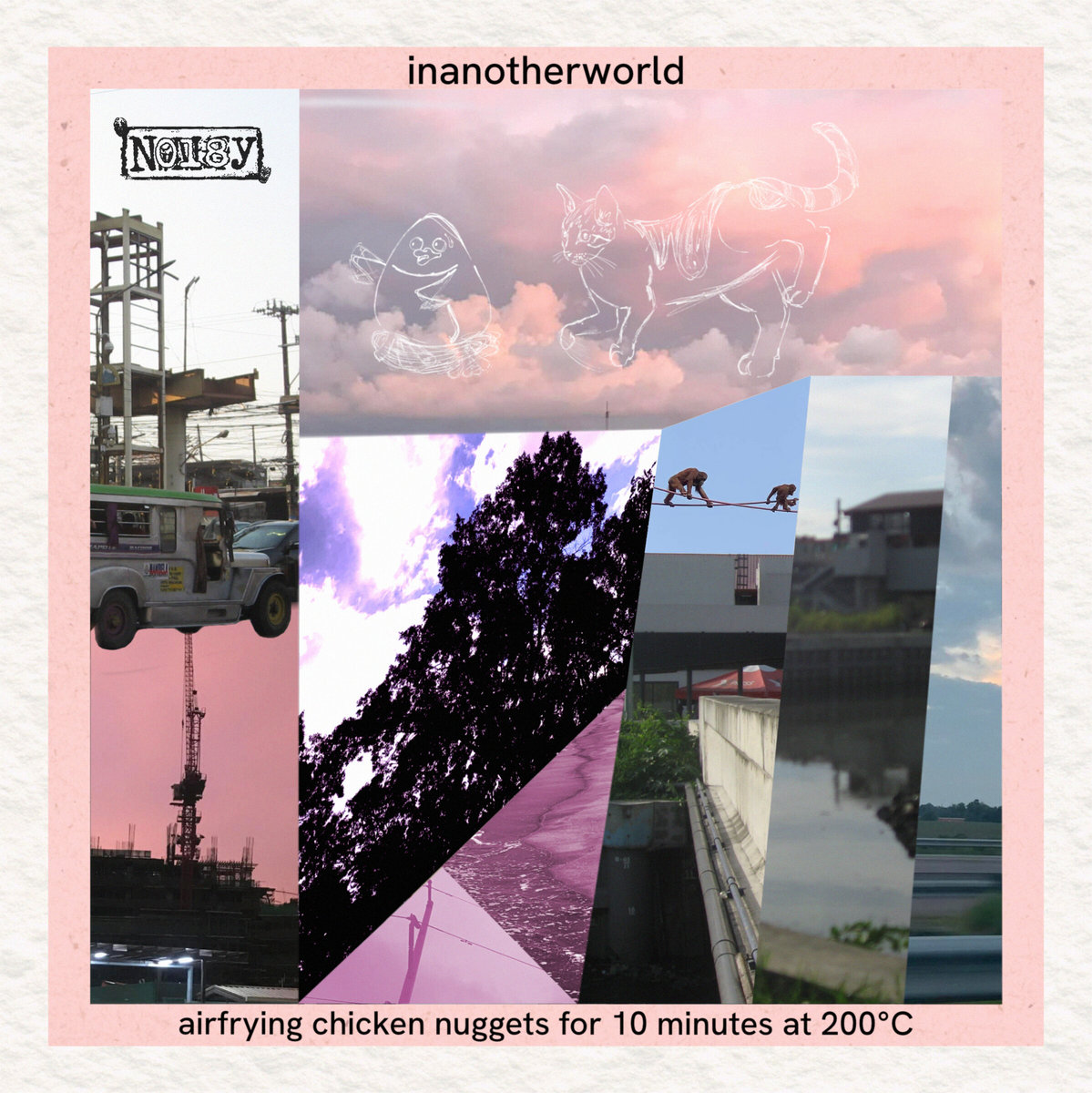
Written by Aly Maaño The beginning of the year is programmed for a personal reset. People eagerly work on their resolutions or, at least, plan the next step. But it’s not always how it’s set out to be. Some are still reflecting on the past year, revisiting old wounds to process what needs to be left behind. inanotherworld’s latest single, “airfrying chicken nuggets for 10 minutes at 200°C,” lets us linger in this period of reflection before release. This five-minute track blends the heavier sound of shoegaze with the slacker tempo and somber composition of slowcore to capture the dissonance of existing in a world that rewards constant movement over stillness. It starts with a chaotic frenzy of drums, pedal distortions, and glitchy frequencies that seem to echo an initial frustration. But it’s nothing that a long walk can’t subdue. This is what the first half of the song feels like. A long walk around the city after coming back from school or work after the holidays. The gloomy tone of the guitars pulls the listener out of their reality to observe what lies beyond the concrete jungle and urban sprawl. Even with melodies meant to evoke a melancholic mood, the track ironically inspires the listener to romanticize life and find serenity amidst the chaos. With beautiful, ghostly vocals accompanying sparse instrumentation, the experience is stretched out into a hundred blissful moments. As seen in the track’s cover art, snippets of the cityscape feel like a much-needed pause to take everything in. By the second half, “airfrying chicken nuggets for 10 minutes at 200°C” unfurls into a euphoric outburst, bringing banging snares and heavier riffs forward. During this prolonged sequence, a sense of comfort is instilled through sound rather than emotional lyricism. The repetition of downbeat melodies is meditative, healing almost. In this track, inanotherworld morphs common themes of slowcore — defeatism and somber slow burns — into a calm renewal. It turns a normal evening walk into an introspection while everything else moves in linear time. SUPPORT THE ART AND THE ARTIST:
Tag: Slowcore
ALBUM REVIEW: marcel – marcel

Written by Gabriel Bagahansol When you live through cold weather all the time, you’re always going to find ways to make the warmth you get linger within you. That’s why it makes sense that some of the artists we turn to for moody expressions of emotions, be it through words or music, come all the way from frigid Canada. And somewhere up in Montreal, Johann Mendoza committed to tape sounds that would allow his feelings to circulate through the dense winds of a Quebec autumn. On the self-titled debut album of this project, marcel explores melancholia through slowcore textures and melodies—combine that with its grayscale cover art of clouds and chain-link, and you get a collection of songs that chronicles the doomed fate of young love and its complex phases. This theme is set in motion with the album opener “journal entry,” which acts as a prologue for a story of heartbreak told across seven tracks. On “just one of those days,” marcel recalls the first memory of a past lover. His lyrics on partaking in the reckless abandon of a night out are elevated by the delicate drone of a string quartet – or, at least, a guitar resembling a string quartet, which brings an organic feeling within an otherwise processed soundscape. It’s like catching the cool breeze and falling leaves while walking wasted in downtown Montreal, although the textures do overstay their welcome, to the point where it could leave you wanting to take shelter, lest you get hypothermia. But on “these rotten nails,” we’re taken away from the streets and into the rooms of two individuals processing heartbreak in dim lighting. The chemistry between marcel and guest vocalist kelly elizabeth is palpable as they sing about their perspectives on a failed relationship, though any hope of reconciliation between the two characters is nowhere to be seen: the acoustic guitar-driven half of the song dissolves into a slower, gloomier instrumental as the two singers wonder where things went wrong. It’s fascinating to hear a story being told through the contrast between two guitars that sound completely different from one another. This creative use of slowcore drones and the drama laced within the lyrics are two things that make “these rotten nails” a highlight within the project. “parc hang,” like “just one of those days,” is a song that sees marcel reminiscing about a night out, but with the context of the track that immediately precedes it, “parc hang” becomes the sound of a memory slipping away from the mind of someone who’s ready to move on. The guitars make you feel like you’re watching a videotape of a park while it’s being demagnetized – to the point where all you can see is static, and this is about the only time on this album where you’ll hear them be this distorted. The intro of “end of the line” greets us with the most ornate blend of sounds in the album. Listening to the mix of acoustic and electric guitars and a violin is like stepping into the woods for soul-searching before letting out your frustrations through a chamber-emo song. Like in “these rotten nails,” the dichotomy of sounds within this song adds another level of storytelling, and kelly elizabeth’s backing vocals – which mixes so well with marcel’s lead vocals – is the icing on the cake for another satisfying number. Because marcel mashed together sounds and genres so frequently and so well on the first part of this album, the last two songs, “porch” and “when it’s time to leave,” can be a bit middle-of-the-road by comparison. These songs play their genres straight: the twang of the guitars in “porch” more strongly suggests country-tinged Americana that is well outside the frosty sonic palette you’ve been hearing so far, and the instrumentation in “when it’s time to leave” is the clearest and barest out of all the tracks on the album. But perhaps the cleaner, less hazy state these songs are in, along with their more cautiously optimistic lyrics, represent marcel actually fulfilling his promise of moving on from heartbreak – or, at least, doing so while hoping he and his lover can rekindle the flame someday soon. Nevertheless, these are both decent performances, and it’s still nice to see the snow thaw out for the grass of spring. Though some of the slowcore drones feel like they’re holding on for too long, marcel still showed some strength as a budding singer-songwriter in the indie space with this album. It’s clear that he has an ear for making films out of the sounds he’s working with, a pen that easily captures the catharsis of a broken heart, and hands that let these two elements live in symbiosis, one track at a time. While the final stretch of songs do come off sonically inconsistent with the rest of the album, they’re still good enough to show marcel’s potential in branching out towards other genres of music, and with the core of this album being in a genre that can feel constrained within one particular sound, he might stand a chance to tell his stories well as the seasons slowly change in Montreal. Support the art and the artist:
ALBUM REVIEW: He Forgot He Died – I’ll Be Fine, I Guess
Written by Noelle Alarcon Surrender to the sound. That’s what He Forgot He Died, also known as Tadako, wants you to do. Proudly bearing the title of slowcore, the artist embraces the qualities confined within the genre. It takes from the definitions and descriptions, but “I’ll Be Fine, I Guess” is far from inauthentic. Running a little over 40 minutes, his musings find shelter and comfort in the classifications of his music. Like most songs under the slowcore umbrella, those that make up “I’ll Be Fine, I Guess” accompany and encourage introspection; the discovery of your innermost self. Tadako utilizes the thicker strings of the guitar to echo the weight of vulnerability. This release is as raw as it gets. In “night,” the fourth track of the album, his fingers sliding up and down the frets accompany his somber singing; slightly grating, yet comfortably a sign of his humanity. In “2:34 am,” the crickets and raindrops whisper along the sound of contemplation that drones on. The album’s greatest strength is its candidness; it’s like a friend confiding in you and opening up so you can confide in them too. Though most of the work consists of wandering, with wistful emotions speaking for themselves along the strings of the guitar, it has its moments of upbeatness. They do not reflect vibrance in the traditional sense, though. When there are drums, the ride cymbal and the kick drum are most audibly prominent. They sound more like a heartbeat drumming up during uncertainty; like how the artist admits he doesn’t know where to start in “time.” It’s a skill derived from noticing the littlest details that he’s able to communicate shared anxieties through sound itself. Tadako’s subdued vocals capture the intimacy of his work. His words are simple and read like diary entries; these thoughts don’t rise above the mix, like how vocals usually would. They float through the weighted soundscapes like thoughts at the most quiet hours of dawn; fleeting and indecipherable, honest and filled with regrets. “I’ll Be Fine I Guess” is so undeniably human that it’s heartbreaking, moving, to face the depths of life head on – ”tell mom I’m sorry,” he sings. “I’ll Be Fine, I Guess” explores what there is to do and who to become. It’s an album that knows what it is supposed to be by an artist who loyally sticks to the sound he wants to pursue. In a fast-paced world, people discourage staying in their own comfort zones. This album is a comfort zone worth revisiting and relistening to when things get heavy, especially for fellow advocates of the slowcore genre. The trademark simplicity it carries makes it a sonic shoulder to cry on; an effective set of tunes ready to serve as company. SUPPORT THE ART & THE ARTIST:
ALBUM REVIEW: Noa Mal – The Anatomy Of Emotional Hijacking

Written by Louis Pelingen Starting around 2019 and onwards, no one is putting in the amount of output that Noa Mal has churned out year after year. In other parts of the world, there are a lot of artists like Noa Mal wherein they’re getting a widespread reputation due to how many projects they can consistently release – think King Gizzard & The Lizard Wizard, Viper, and the smattering of obscure electronic, folk, and black metal acts that have that artistic capacity to just brute force their way into a year with 3 or more projects done – looking into the local scene, there is no one like Noa Mal at this current moment. And despite carrying that sort of reputation might be interesting and outstanding to some, that can also be the kind of title that can get frustrating and lead to bigger expectations. Mostly because, with that brand of ‘quantity over quality’ release cycle being stretched over in the consecutive years, the worries surrounding sonic and thematic retreads; lack of surprises in the formula; and meager interest towards improvements across the board will come up more and can lead to going through that kind of discography to be daunting and may end up being less interesting when those boxes are ticked off. Now, after going through Noa Mal’s entire discography, the results can be a mixed blessing. While her brand of lo-fi grunge rock and slowcore comfort zone definitely mesh together easily – her gloomy topicality surrounding relationships and personal angst starts to get extremely thin due to her plain way of writing as well as persistent mixing and mastering issues that doesn’t allow the recordings to blend altogether – there are projects that do show her improving on the composition and production front. ‘Everything Is Science, Baby’ is a good starting point as it best represents Noa Mal’s sound across the board, which you can then follow up on her other 2022 released records like ‘My Corrupted Hard Drive’ that leans on the softer grunge and slowcore cuts and ‘Fear Fiction’ for some synth implementations that she’d eventually explore even further just this year with ‘Suspended Animation’. Going through with her tradition, ‘The Anatomy of Emotional Hijacking’ is her 3rd record that she released this 2023, just after the volume and banger heavy ‘Holy Hour’ and the synthetic drum and synth-inflected ‘Suspended Animation’. It continues to retain Noa Mal’s compositional strengths on the record, from the moody drenched ‘The Actress’ where Noa Mal’s prim vocal lines work well with the wavering guitar licks and percussion beats, the trudging indie rock of ‘Luci’ and ‘Deeply Tinted Glasses’ as the former staggers through due to the quicker flash of melodies alongside these carefree vocal lines and the latter coasts through grungier guitar lines that adds into the smoked out vibe of the track, the sunnier indie rock of ‘Dance For Me, Puppet!’ with the gliding vocal melodies amidst the stable fuzzy drums and brighter guitar lines, and the tempered acoustics of ‘Sepanx ka nanaman’ that brings an open space away from the numbness of the moment. As said before, with her writing surrounding numbing cycles of relationships and personal angst that has gotten stale that doesn’t give her a lot of favors at this point, the writing this time opens up Noa Mal’s writing scope as there are a couple of songs that provide more context towards the relationship that eventually fluctuates before it even started. The universal sorrow of ‘Luci’ that tackles the loss of everything and everyone as well as the social exhaustion of Noa Mal’s generation represented through Luci is an example of this that continues further with ‘Dance for me, Puppet!’ through the puppet metaphors as well as the glancing subtext of familial disappointment on certain tracks like ‘Intro: Hijacked’, ‘My Golden Town’, and ‘Sepanx Ka Nanaman’. These moments do add more to Noa Mal’s dulled-out relationship throughout the record like the tiring cycles of everyone showing her how to love on ‘The Actress’ which eventually colors how the numbness that she feels creates a different tone to the “love songs” of ‘The One Who Really…’ and ‘My Golden Town’. Songs may have this emotionally intimate tone to them, but given the context of social exhaustion from her peers and the personal dullness from all the cycling relationships, it’s now put into darker framing wherein Noa’s numbness has now bordered into irrationality, making the relationship an emotional hijacking that she eventually disposes away on ‘Sepanx Ka Nanaman’ and eventually succumbs to more layers of numbness that makes her feel free at the very end. Despite the strengths that Noa Mal has honed in on this record, the mixing of the record does get a bit uneven, more so the guitars and drums that do peak on the mix. While this issue does permeate on her 1st 2023 record, ‘Holy Hour’, it is at least consistent in terms of how loud it can be that does get compensated with punchy grunge melodies just flooding through and through, while ‘The Anatomy of Emotional Hijacking’ takes those grunge melodies with a sunny like flair that does need more balance on the mix. And despite her writing that does work a lot more in this record, it did stumble on ‘Angel of Romantic Death’ with the plainspoken metaphors that may show Noa Mal’s agency but just ends up being clunky as a result. But overall, ‘The Anatomy of Emotional Hijacking’ might not feel special in Noa Mal’s ever-growing discography at first glance even if the composition still does come off as developed, the writing and emotional throughline on the relationship Noa Mal is presenting here offers a different layer and side of her style and framing thus far. A lot more tangled and is paired with an extra set of context around it that does broaden Noa Mal’s skill as a writer given her plain style of writing hasn’t stuck out much in her past records. It’s very