
Written by Julia Harumi Kudo
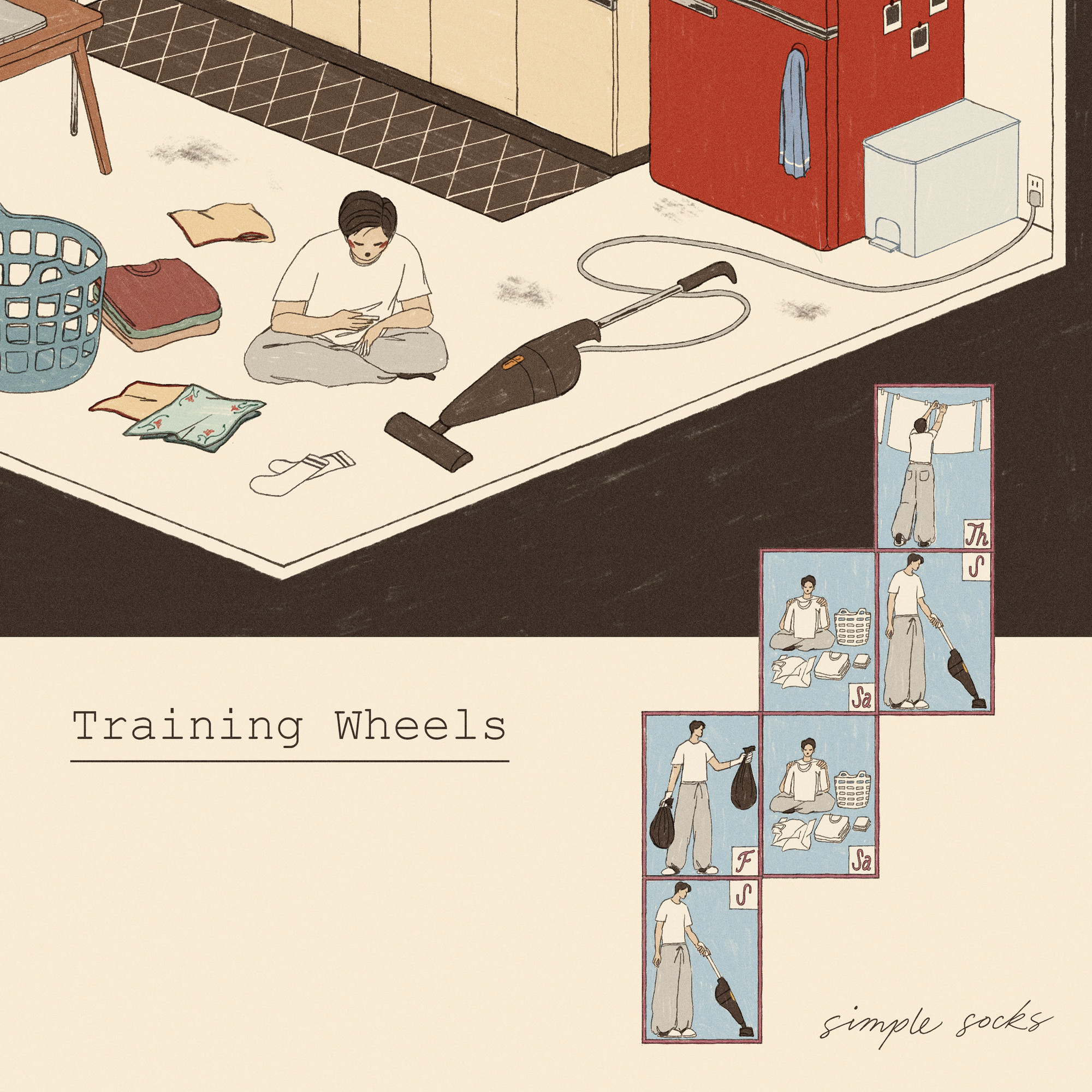
“Training Wheels” begins with the clicking sound of a bicycle’s freewheel. The song pedals a new echelon for Iggy San Pablo, the Toronto-based Filipino musician and Rusty Machines frontman, now recording under the name simple socks. Before the instruments break away in the track, there’s a nervy tick of motion without propulsion, that even after your body has stopped pedaling, your motor memory is still trying to justify itself. A siren shrills within earshot, then someone honks as the voices blur, but the city continues to move, ignoring them all. Then the guitar interrupts the street’s noise, sharp and precise with a crisp rhythm, while the drums stall like an engine refusing to start; every sound seems to hesitate between movement and paralysis. And simple socks’ singing is restrained, as though driven by survival instinct, like the voice of someone desperately and politely trying to suppress their emotions so as not to explode in public.
What makes “Training Wheels” so compelling lyrically is how it consistently frames migration as this never-ending process. Iggy San Pablo writes about distance without romanticizing sacrifice this time. “It’s a long distance away/Still call you anyway” conjures a forlorn intimacy with phone calls from overseas during different time zones. One person is wide awake, while the other is fast asleep on the opposite shore. As the song reaches its midpoint, it becomes clearer that the very essence of conviction is slowly coming into focus, culminating in the lyrics, “The pavement’s rough, but I know I need to move along.” He repeats the phrase “I need to move along,” but it no longer sounds like a source of motivation; rather than an affirmation, it starts to sound compulsory, a survival strategy.
But there is irony at play in all of this. Expressing the alienation of immigrants through English, a language inherited and symbolizing both hope and the scars of colonial rule, is already analogous to surrendering a part of oneself to translation. The memories of diaspora are rarely passed down in their entirety. “Training Wheels” lives precisely within this contradiction. To live between two countries means not fully belonging to either, caught between the homeland from which one grew up and left and the hostland that still treats you as provisional. However, this song refuses to succumb to self-pity. After the final repetition, what remains is not despair, but momentum. The freewheel clicking at the beginning returns as a metaphor for the momentum sustained by past efforts, even if the direction is uncertain. Iggy San Pablo’s greatest strength as a songwriter lies in his restraint. He never exaggerates his experiences into grandiose political revelations, and this stance remains unchanged. The production stays lean and restless, the guitars don’t smooth out the arrangements but rather create gaps, and the drums are always in danger of completely losing their rhythm. “Training Wheels” remains hopeful precisely because it refuses resolution. Iggy San Pablo does not land on wholeness by the end of the track. He simply keeps pedaling. In lesser hands, that ambiguity might feel unfinished. Here, it feels honest.
SUPPORT THE ART & THE ARTIST:
Leave a Reply