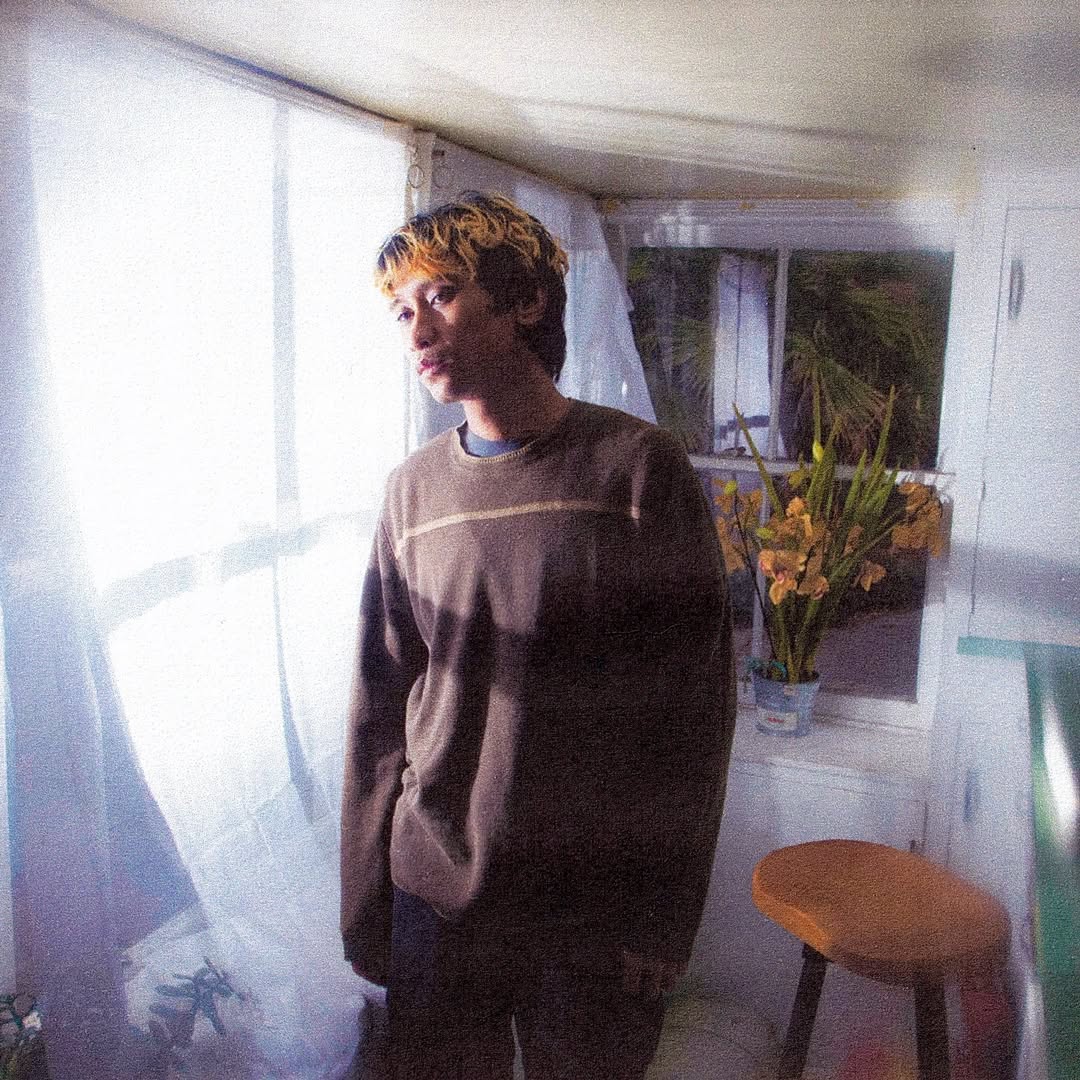
Michael Seyer, Do You Have What It Takes To Be A Man?
Interview by Faye Allego
Music has been a diary for songwriters for centuries, and Michael Seyer is no different. But how does a man write his legacy?
Memory is ever-changing and sometimes fails to hold still. However, when used in music, we can preserve them forever. In his latest release, Michael Seyer introduces an amalgamation of his memories and experiences on boyhood vs manhood, family, love, and ghosts in Boylife. For nearly a decade, Seyer’s rise from the bedroom music scene has been unhurried and steadily paced – his distinct lo-fi, jazz-tinged dreampop and vintage soul sound originated from his 2016 debut album, Ugly Boy, and is further intensified in 2018’s Bad Bonez. Seyer’s diaristic lyricism, as well as sentimental textures of Japanese city pop and the reminiscent glow of early OPM influences in his 2021 album Nostalgia and throughout his discography, he never strays away from an inward gaze of his identity and perception of love. Talking to Michael Seyer from one bedroom to another at different sides of the Earth felt like catching up with an old mentor from high school, you really learn the essence of ‘dudes just being dudes’ who are really in tune with their passion. During the interview, he mentions that music is all he really knows, and it was said in the same way that Alex G thinks he’s a very boring person, from the receiving end of things, it’s honestly far from the truth.
**This interview was conducted in June 2025 and has been edited for clarity and brevity.
FA: Do you know what Lugaw is?
Seyer: That sounds familiar. You know what? I love the Philippines. I was born there, but I left when I was three or four. So yeah, I just, I didn’t do my very best to keep the good look in my mind.
FA: So, Lugaw is Porridge. Where in the Philippines were you born?
Seyer: I was born in Manila.
FA: Is nostalgia a recurring theme in your work? What role does memory play in how you write music or understand yourself?
Seyer: I write about memory for sure, but it’s not the most overtly “themed”. It’s more in the sense that I write [about] my experiences. So, in that kind of really far stretch of my experiences, are my memories. Mostly, I’m writing about me looking back at certain things, how I am now, you know? Memory drives the music. I tend to write songs or do things in a way where it’s the music that I have found the most fond in my memory; I try to make my music sound in that way, that whole nostalgia EP, I was really into a lot of the Japanese city pop and even a lot of OPM music. I have always been listening to that kind of stuff. Even as a kid, I remember listening to it. I would take things from music that have really affected me in the past and then use that as a jumping-off point. I guess for this recent album, I was writing… a good amount. One of the songs on the new album, “1995”, that’s the year I was born, [and] I wrote that song specifically about the Philippines. The way I remember the Philippines is not– I don’t have a very concrete memory of it. I left when I [was] really young, and I came to America. So, a lot of the stuff that I do remember from the Philippines is really just abstract, senses, taste, and maybe the few images that I do remember, they almost feel like an old film reel that’s [a] really colorful and nothing is really graspable. It’s really ethereal. I was trying to write a song about the Philippines with my very limited memory and my really abstract memory about it. So those are a few ways, I guess, nostalgia or memory comes into play.
FA: Are there any Filipino artists that are from the past or present that you’re curious about, in terms of musical influence, and your new record label, Seyerland?
Seyer: Yeah, that’s a tough thing, right? We’re in a kind of an interesting situation with Filipino visibility, right? There aren’t many artists to really pick from, especially in my lane of music [in the West]. We have that Filipino Pride…Once anyone’s a fucking drop of Filipino, we claim it. That being said, there’s nothing there’s not much range that I could pick from. Obviously, I love all kinds of music. So I am always listening to everything, especially with OPM, Hotdog, and Bong Peñera. My parents would always play Parokya Ni Edgar, Eraserheads. Yeah, it’s… A lot of old stuff. I would love to find some artists that are more contemporary in that lane, and we don’t have that many options to pick from. So I’m just always trying to find new music. and I definitely want to encourage Filipino artists to carve out a lane for themselves, and I want to discover more artists who are Filipino [and are inclined to make] great music. Because we’re a fucking–we’re a musical culture. Nine out of ten of us can kill it in karaoke and belt out of nowhere.
FA: You released your new album under your new independent label, Seyerland. Are there any lessons and niches you have gained in the behind-the-scenes process of starting your own DIY label?
Seyer: Well, you know what? I am only a month into it. I’m not sure if I have any lessons to give anyone, but [a] part of the reason why I want to do this is because I’ve been doing [music] for a really long time– almost 10 years now, and through that process of being forged to release on my own [music], because I haven’t really had any connections. I was just someone who threw a project on the internet and then fell into this. I saw maybe a few people appreciate it, and then at the same time, this is what I love doing. I don’t have any skills besides making music. Since I’ve been doing it independently, I at least would really love to step in and give back to locally based smaller musicians and maybe equip them with small tools that help them slowly build a sustainable career that is pretty self-sufficient because I’ve atleast been able to do that, in some way, it might be relatively modest compared to what other artists have put out for themselves, but I can feel confident to say that I’ve done it myself and I own my own music, I hold no allegiance to a record label or any industry thing. And it is hard as fuck, but I think it’s worth it. In my formative years, I’ve met a lot of super impactful artists, who were cut from that same cloth, where they were like “Oh, we’re doing it ourselves, this is how you do it!” And I [am] definitely taking a page from their book in some ways. I’d love to do that for another artist.
I think you should you should always let yourself be. Especially with being an artist or not even being an artist, but being a person, being a human. I don’t think there is a means to an end to justify humanity. I think it’s a means in itself, just by virtue of experience; there is no end goal to experience or humanity. It’s simply to be.
FA: Boylife is an album that doesn’t insist on resolving the chaos of boyhood, but instead, embraces it. What did boyhood or “manlife” mean to you while making this album?
Seyer: When I wrote the first few songs for Boylife, I remember, I think one of the first ones I wrote was “Boylife”, and it had that little chorus around just saying “Boy Life” over and over again. I love that word. I don’t know why. I think it’s really random, but one of my favorite words is “boy” for some reason. I don’t know, it resonates with me, Ugly Boy. Boylife. And then I wrote that song. Usually, at least for my experience, the album process is you write the first few songs and then some of the first few songs inform the sound and the theme, and then from there, it just comes into fruition by itself. [Then,] you start to write about generally the same stuff. So I wrote the “Boylife” song, and I guess I was in a mood where I was writing a lot of stuff that was pretty related to how I see myself from a formative perspective, coming into a much older person. I just turned 30, so it was a big one, and I’ve been doing this for a really long time, so that was on my mind. So I just continued to write about themes of youth and growing up and maturation, which is always a present [theme] in my work. There’s always that recurring theme that an artist always writes about– I’m always interested in writing about how someone’s experiences also informed who they’ve become, really.
FA: Do you ever feel pressure to define who you are as an artist, or do you allow yourself to remain in that space between becoming and just being?
Seyer: Very ethereal question, huh? There’s always pressure for an artist to kind of prove themselves to other people or whatever it is, even not at a non-artist level, we always have something to prove, right? Whether it’s in a workspace or a social dynamic or an existential way, I think just us as human beings, we’re always inherently thinking about our place in the world, and it gets even worse when you’re an artist. Because sometimes your artistry is really just intimately connected with what you think and your purposes. Obviously, that’s the case for a lot of things, but I have learned that that’s not necessarily the best thing. I think you should you should always let yourself be. Especially with being an artist or not even being an artist, but being a person, being a human. I don’t think there is a means to an end to justify humanity. I think it’s a means in itself, just by virtue of experience; there is no end goal to experience or humanity. It’s simply to be. I think we should live our life that way, and it might help us be a little more radically present if we kind of approach it that way.
FA: That’s some George Harrison ass answer, dude. I love that.
Seyer: Yeah, I don’t know, man. I mean, I was, yeah. It’s my college. It’s my college fucking background. It’s fucking critical thinking and shit,
FA: What did you major in?
Seyer: Creative writing.
FA: That’s so cool.
Seyer: I guess, well, I’m not doing shit with it. […] but, yeah, I fucking love college, to be honest. It’s like, you get to meet just the most random fucking people who are just the biggest weirdos! You meet people and you’re like, “dude, what the heck? Why are you this way?” I don’t know. [Laughs] Yeah, and you start to love whatever the hell is wrong with people. It’s great.
Whenever I go into a church, there’s always this sick ass fucking piano and a sick ass organ, and then the ceilings are so high that there’s natural reverb and acoustics that are really good. Even though I don’t believe in religion, I love the overall atmosphere. I think that is the same thing with ghosts. I don’t believe in it, but I love the idea of it.
FA: When you’re trying to translate something so internal into sound, melodies, chords, and rhythms, you mentioned earlier that there is that pressure to it. So, when you’re an artist, that pressure seems to amplify ten times more because it’s also essentially displaying your work in front of people to listen to and see. So, how does your songwriting process look?
Seyer: It’s different every time, really. Sometimes I start on the guitar, sometimes I start on the piano, sometimes I have a phrase or there’s something I want [just] to write about. It really differs so greatly between songs that I really could not tell you one definitive answer. I think it always starts with making the time to do the “thing”, right? So, yeah, I’m pretty good at that. I mean, I was better when I was younger, for sure. Now I’m just like, you get old and you have baggage. But I think, generally, I’ve been pretty good with– no matter what it is–taking the time to allow yourself [to create] a time frame to put yourself in front of whatever it is– the computer, the guitar, the piano, just to do your due diligence and let the thing come out, I guess.
FA: Yeah, practice makes perfect or intense lore! You mentioned a while ago that “boy” is your favorite word and that it’s just something that kind of reappears in your head. I also noticed that one of the people in your comment section on Instagram commented that in your other songs, you use the word “ghost” a lot. Is that on purpose?
Seyer: I mean, I guess it’s on purpose, but it’s not intentional. There’s just some things we gravitate towards, I think most artists have these revisited themes that they go through. And I don’t know. I just, I really love the fucking imagery of a ghost and what it means just on a symbolic level. Or just the iconography of ghosts throughout. Yeah. Just fucking various cultures and shit. It’s just such a potent word.
FA: Do you have any ghost stories that you might want to share?
Seyer: No, actually, I don’t really believe in ghosts. I’m explaining this in a roundabout way, but I grew up Catholic– I don’t want to gravitate towards religion at all. Even when I was young, being brought to mass, I was a six-year-old and already thinking, “this is so fucking boring, I don’t want to be here.” When I entered the church, the air felt heavier. But I love going into churches now as an adult because even though I don’t really believe in Catholicism or Christianity, the iconography of churches, the stained glass windows, and the murals of Jesus on the cross, and the wooden pews. Yeah. All of it, there’s this atmosphere that [now] feels really great. Even being a musician, whenever I go into a church, there’s always this sick ass fucking piano and a sick ass organ, and then the ceilings are so high that there’s natural reverb and acoustics that are really good. Even though I don’t believe in religion, I love the overall atmosphere. I think that is the same thing with ghosts. I don’t believe in it, but I love the idea of it.
Music has always been just this overarching theme of my life that I will always have unconditional love for, but especially in making different albums, I have to constantly remind myself why I fell in love with this. And I think we can do that with a lot of things. And I think it’s a thing to remind yourself that’s worthwhile of why you love these things.
FA: It’s a very Filipino phenomenon to grow up practicing Catholicism. It’s also a very Filipino trait to be family-oriented, and this applies to the family dynamics, too. This is reflected in your discography in songs such as “Father”, “Chemotherapy”, “For Mother”, and even your cover of “Raindrops Keep Fallin’ On My Head”, which was uploaded onto your YouTube Channel. What keeps you grounded with your culture, and how do you think that reflects in your music?
Seyer: Yeah, I mean, yeah, [cultural influences are reflected] in my music because I’ve obviously written songs about my family. I think it’s always been positive. I’m one of the lucky ones. I know there’s a lot of chaos and sadness in the world, where sometimes you don’t get the privilege to say that I have this really great relationship with my family. I really feel for that because I think anyone who is [alive and] living has someone close to them; friends, partners, whatever it is, and they see that come into play very vividly. I don’t take it for granted because I had a really great childhood, and my parents were the best. They loved me. Whenever there was something that I needed, they provided, they worked hard, and I’m truly indebted to them for making me the person that I am. They always encourage me with music, even though they were not really encouraging. They were half and half, where they said, “Okay, that’s cool, do this thing you like, but also go to school.” I think that’s reflected because most of my songs are extremely positive, and they made it pretty easy for me to feel really close to them because they were awesome parents. My parents were always very encouraging, and they made it really easy for me to be vulnerable. Obviously, I can be better. There’s always something. There’s always a next threshold to aim for. And I guess music is the way that I do it.
FA: What has writing boy life taught you about love, not just romantic love, but familial or self or even artistic love?
Seyer: I think even on all levels–whether it’s artistic love or loving another person or a general, platonic idea of love. And this is just speaking for me, everyone has their own philosophy that they could abide to. But I truly think love is active. I think love for anything, whether it’s in someone or an art, I think it is effort. You have to put in effort. You have to put in the time to nurture that love. Obviously, on some level, there is that unconditional love that is just working as a passive mechanism. But I think that only is nurtured when you put yourself in front of it and show up for it and are actively, radically present with giving that love some weight, you know? So, yeah, a lot of the time, making an album for me is trying to remind myself why I love music. Again, you make the thing, and then you fuck off. You go do the other stuff and experience whatever, and then you kind of at some point are, “Oh, I gotta do it again.” And it’s always this process that’s maybe, at least for me, somewhat grueling. And then you have to slowly remind yourself, “Why do I love doing this?” And then you get to this moment where you write a song, and then you go “Oh, I LOVE this, I’m kind of getting high off of this. ” Then you’re making more songs that build off those songs, and then you’re reminded again why you fell in love with this in the first place. So that music has always been just this overarching theme of my life that I will always have unconditional love for, but especially in making different albums, I have to constantly remind myself why I fell in love with this. And I think we can do that with a lot of things. And I think it’s a thing to remind yourself that’s worthwhile of why you love these things.
Where we are at, it’s much harder, especially with a lot of the venues– if you compare how many venues there are now to back then that are operating on a DIY level, we’re [now] living in a post-Live Nation post-Spotify realm.
FA: How do you decipher which mediums to publish your art in?
Seyer: That kind of [medium] asks you to do it a certain way, to be honest. If there’s a song that I write, you can write it in, but I think at some point in making the song, there’s going to be some point where the song is asking you to do it a certain way, right? So I think that’s what dictates what medium or at what certain process the thing needs to be made; I remember there are a few songs that I have in my catalog that were poems, […]I would just write it and I’d think: “This is kind of sucks as a poem”, and I remember taking the poem and just based off of the lyrics and put it onto a song instead. It at least felt to me a little more natural in that place. I think sometimes you can kind of tell, especially if you’re getting a little comfortable with creating art, whether or not something necessarily works in that medium. I guess I just try to trust that intuition of “Maybe it needs this certain thing and it’s not necessarily thriving in this kind of lens, so let’s put it on! If you want to put it on, you can just trash it if you want,” but yeah, I’ve done that quite a bit where it [would start as] poems and then it’s not working out and then I put it in songs or vice versa. So, yeah, just trust it, you’re good.
FA: You once mentioned in an interview that you started making music in your mom’s garage in California. Did you dive into different underground scenes there? How do you compare that to touring?
Seyer: It’s interesting because I kind of grew up in a DIY scene, but I wasn’t as invested as other folks. I [gained] a little taste from DIY scenes, and then I put out my first project, and then from there, it was mostly focused on the internet DIY scenes. But, yeah, just being around music as much as I can, I’ve had the liberty to be in a lot of places and experience other people’s social bubbles. I like so many different ranges. And it’s really cool to see that little bubble and how those people operate in some way. I’d love to just experience that again. In this day and age, there’s not a lot of support, I would say. That sucks to say, right? And maybe I’m not tapped in that way because I’m sure there’s always going to be an underground DIY thing that’s operating. But I feel like, as of right now, where we are at, it’s much harder, especially with a lot of the venues– if you compare how many venues there are now to back then that are operating on a DIY level, we’re [now] living in a post-Live Nation post-Spotify realm. And also, things are just astronomically so much more expensive compared to [DIY]. Even just the idea of touring is not conducive unless you have a lot of I don’t know, support capital or whatever you want to fucking call it. So yeah, I’d love to see [the DIY scene] encouraged a bit more. It’s hard as fuck right now because we’re living in the late-stage capitalist time frame. I’d love to see the scene more encouraged because when you do see it, when you see a self-sufficient underground DIY scene, it’s really special.
FA: What made you want to work with Justin Quinell for the cover art of Boylife?
Seyer: Even before I started making the album, that [image art later used for Boylife] was one of my favorite photo images; there’s something intimate about it, but also really unsettling. It’s almost like it’s something intimate and not intimate at the same time because of how surreal it looks. That image deeply resonated with me. I was almost keeping that image in my head while I was writing these songs: what would the soundtrack to this image sound like? It was a really big help on trying to trying to craft the general sound for the album. Because I always go a little differently every album! We were entering to a more acoustic-oriented folk territory. But yeah, I really love that image, and he’s one of my favorite artists in photography. I remember when I finished the album, I was pretty head set on having that image in there because it felt so formative to what the music was sounding like. I reached out to him, and I guess he was a fan of my work too. I was really happy that he resonated with my music, and I resonated with his photography, and there was a good mutual exchange between artists that are just fucking liking each other’s work. He’s a super cool guy.
FA: Do you still resonate with your lyrics from your previous albums?
Seyer: I like to page through this artist that I really love. A lot of [Boylife] is influenced in certain ways by him. I love Cody Chestnut, and he put out this album called “Boy Life in America”. Or actually, no, that’s the first track in the album. Cody Chesnut put out the album called The Headphone Masterpiece. I remember watching this interview because I love that album, and he was just talking about whenever he listens to it and when he was making it, he just heard a young man who feels that felt lost and is trying to find their place in the world. In a lot of ways, that’s how I feel when I listen back to Ugly Boy. I hear a lost young man trying to just figure himself out. I guess in that journey created some music that maybe resonated with some other folks who felt the same way. In a lot of ways, I guess this new album was a love letter to that of my first album. It’s revisiting that theme of feeling lost, but now that I’m older, I ask myself what other insights can I gain from that same sentiment? because things are really different. But very similar at the same time.
FA: That feeling of being lost is so evident at the end of the 6th track, “Manlife”, I’m sure that’s the interlude portion of the album, and there’s a voice call at the very end that’s, I believe, from your dad. It points out the redefining moment of reassuring yourself that you’re okay, and it’s okay to be lost. When there’s so much rubble and noise around you, there’s that one familiar voice that makes you think, “Oh, okay, I’m safe.”
Seyer: Oh, for sure, because, you know, I think that’s such a fucking, it’s such a loaded question to unpack of what it means to be a man, you know? But at least from my experience, when I try to think about what a man is, there’s very superficial answers to that; a man could be someone who has power. A man could be someone who makes a lot of money. A man could be someone who gets chicks or whatever, I don’t know. And that’s not any of the things that informed what manhood [truly] is. I’ve had to learn that the hard way, being a young, misguided boy who struggled with masculinity and misinforming themselves of, “maybe if I get this,” or “if I do this, it will make me more of a man,” even though that’s not really how I am inside. I’ve had to learn that, and I think most kids had to grow up and realize, and mature. When I think of what a man is, I think of my dad, because he’s just kind. He’s in touch with his feelings. He’s always been really mindful of others. I guess that’s what I was trying to do with the “Manlife” interlude. I see [my dad] as the epitome of manhood in some ways. Hearing that voice at the end is the most grounding thing when you think about such a heavy question that just bounces around in your head.
FA: You mention on your Instagram story that John Lennon’s solo work, particularly the album Plastic Ono Band, heavily inspires Boylife and the rest of your discography. Is John Lennon your favorite Beatle?
Seyer: You know what? I feel on paper, it should be Paul McCartney. I like more Paul songs. But for some reason, just John is the GOAT. That’s all I gotta say. He has that thing in him when he makes a song that just feels really good. Something that an artist would make, right? So, yeah, I think technically, maybe Paul, but I love–really intensely– a lot of John Lennon songs.