
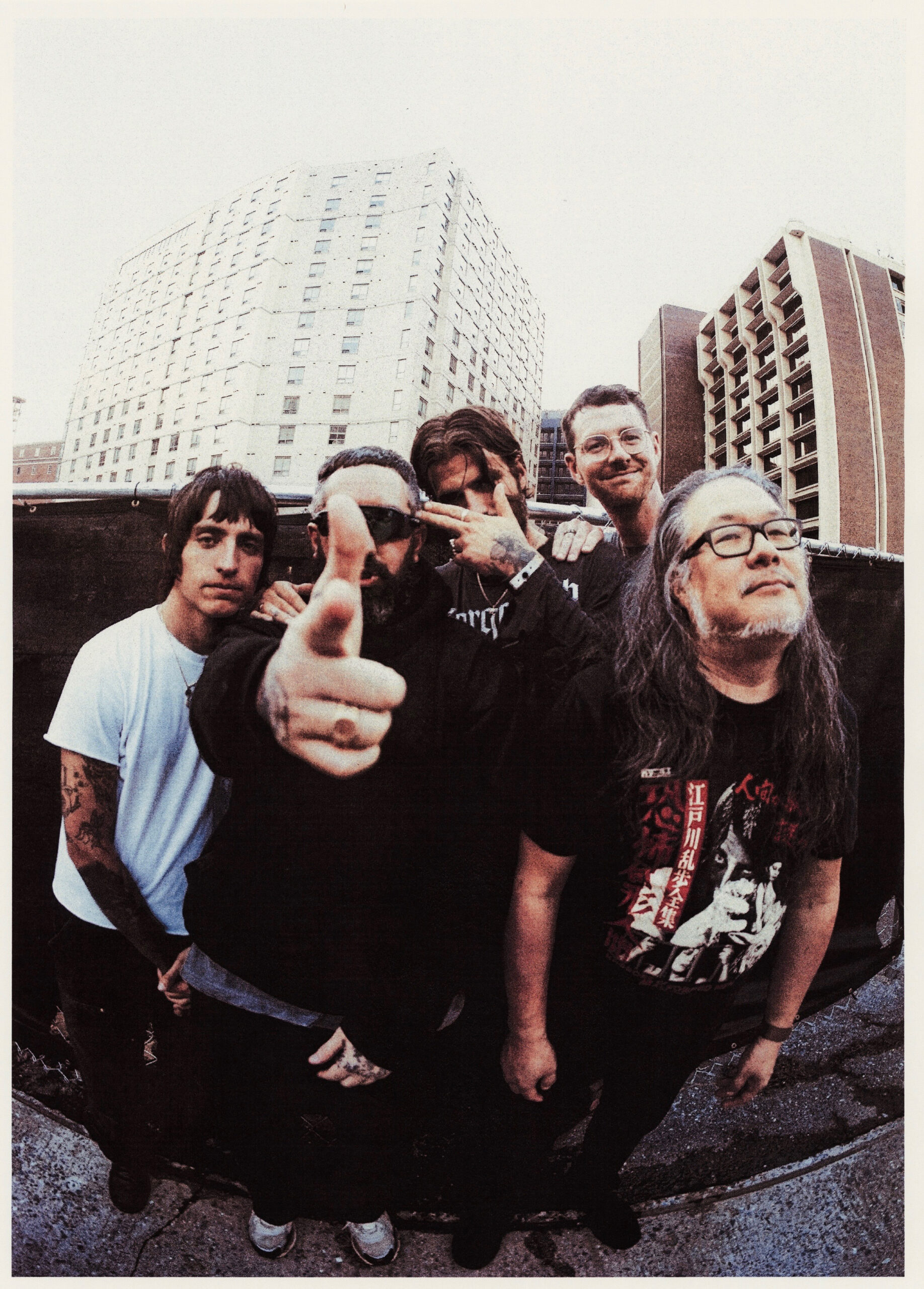
After more than a decade in the game of nu-gaze, Nothing has become some sort of fortune teller of what comes next in a scene that has spent years celebrating its own revival. The mastermind, Domenic Palermo, has challenged how people perceive the genre and reworked its formula, all with the help of his background in hardcore, in both lifestyle and sound.
From playing in bands like Horror Show in 2000 and eventually recording Guilty of Everything in 2014, to headlining ballroom stages at his very own curated shoegaze and dream pop festival, Slide Away Festival, Palermo has always thought forward and never backward. A scene that celebrates itself would eventually have to relearn the genre over and over to avoid stagnation. This is what Nothing has been doing, ironically enough.
Palermo and company have visited Manila three times at this point, and the noise has never faded with each visit. Their first time, dating back to early 2017, found Palermo in what he admits was his worst mental state. Their second visit in 2019 came with a more robust lineup, with Palermo in a clearer headspace and planning on ringing the ears of the uninitiated. Their most recent visit in July 2026, to me at least, showed the band in its most complete, realized incarnation to date. Their latest album, a short history of decay, also reads like a diary of the band’s trips abroad.
As for the state of shoegaze, it is melting into the ether, slowly reanimating into a more chaotic, digital monster, far removed from its original form. Palermo willingly embraces the change, as everyone should in the long run. The “decay” in question might be a metaphor for recovery, or maybe it is a commentary on the state of the world, where music exists as a coping mechanism. Who knows? Palermo has his own answer. This interview took place literally 20 minutes before the band showed what “decay” means in the form of sonic warfare for the eardrums at Aster Events Place, Mandaluyong City.
[This interview has been edited for clarity and brevity]
ELIJAH: I was there in 2017 for your first Manila show. Could you tell me what life was like at the time? It’s a bit of a nostalgia trip at Checkpoint Bar in Paranaque City.
DOMINIC PALERMO: I guess 2017 was a pretty chaotic time. We had just finished the touring cycle for Tired of Tomorrow, and that was right around the time when I got my head bashed in pretty good. Everything was really crazy for me mentally at that point. I was suffering from a lot of depression, paranoia, wild mood swings, and stuff. I was taking all these different types of medicines from my neurologist, so touring at that time was really crazy because I was still doing typical Nothing stuff, like drinking and partying, but I was on all these pills, and obviously my mental state was not really great. That’s probably where I was at that point. But we were also getting all these opportunities to go on tour and visit places we had never gone to, or places I didn’t think I would ever make it to anyway.
ELIJAH: If we could dial the time back two years before that, to Guilty of Everything, it’s now become one of those records people point to as the start of the modern shoegaze revival, at least for me. At the time, did you see Nothing as passing the torch of a genre, or were you simply trying to make sense of your own life through music?
DOMINIC PALERMO: I didn’t really have any intention of doing anything that we wound up doing. For me, that record was a bucket-list type thing. I always wanted to do something away from the hardcore stuff, and I didn’t really have the tools to do it for a long time, or the courage to even try. I was carrying a lot of trauma on my shoulders for a couple of decades, and I wanted to get it all off my chest. That’s what that record was for me. Pure and simple, the goal was just to get that record done, to address two decades of pain and whatever else. Then it kind of sprawled out of control, and here we are, 11 or so years later.
“I realized during Horror Show, playing shows, that I was able to release some of that darkness when I played and recorded. It was really the only way I knew how to get that release.”
ELIJAH: Time flies. It’s been 12 years. You mentioned earlier that before Nothing, your story was already defined by trauma and starting over. When you finally committed to making music again, what made you believe that writing songs could express those experiences better than simply leaving them behind?
DOMINIC PALERMO: I think music has always been like that for me. When I was younger, I played in Horror Show and stuff like that. It was the same kind of recipe, basically. At that time, there was a lot more anger in me. There was still depression, but it was pushed and backed by angst. I realized during Horror Show, playing shows, that I was able to release some of that darkness when I played and recorded. It was really the only way I knew how to get that release. With Nothing, it was a big jump for me musically, but the goal was to see if I would get the same kind of reaction.

ELIJAH: That’s a great way to put it, because a lot of heavy music uses volume as catharsis. Nothing often feels numb to me. At least when I saw you guys for the first two times, it almost felt numb beyond being deafening. Was that emotional tension always intentional, or did it naturally become part of your songwriting as you processed different chapters of your life?
DOMINIC PALERMO: I think Nothing’s live shows were really loud and aggressive for two reasons. One, I wanted the recordings to sound different from what the live setting was going to sound like. I come from an extreme music world, and it’s aggressive, so I wanted Nothing’s records and live shows to always be different. A big part of it was also just not knowing what to do to get the sounds we needed for Nothing. So it was being aggressive for several different reasons, and being loud.
ELIJAH: I kind of noticed that My Bloody Valentine, for instance, was informed by the post-punk and jungle-pop scene in Ireland and the United Kingdom. To me, American shoegaze has always been informed by metallic and hardcore leanings, and that fascinates me, how sounds develop over time, especially extreme or heavy music over the past two decades. Since the pandemic, shoegaze has become one of the internet’s fastest-growing guitar scenes, but it’s also been folded into countless microgenres and algorithm-driven labels. As someone who’s watched the genre evolve for more than a decade, what excites you about this moment, and what do you think gets lost when scenes become internet aesthetics?
“Seeing people run with our recipe, it’s like, okay, we can’t make the same record again.”
DOMINIC PALERMO: It’s a bummer and it’s exciting at the same time. I do think Nothing is responsible for a lot of what’s going on, and there’s good and bad in that. I see certain things happening that are hard to watch, and then you see some really cool stuff coming out, too. It feels like people could get hung up on the genre elements as well as the new and interesting things that are coming out. Doing Slide Away Festival and stuff like that lets me tap into these younger bands that are doing really cool stuff. I also have to live with the fact that I see really bad stuff happening, too, and I do feel directly responsible for some of that.
ELIJAH: Speaking of Slide Away Festival, you’ve gone from being a musician to helping curate the genre itself, at least through the festival. What responsibility comes with deciding which versions of shoegaze get represented, especially when you’re bringing together foundational bands like Chapterhouse alongside newer acts?
DOMINIC PALERMO: For me, it’s a good way to keep my hands on the steering wheel. I haven’t had a lot of help through the years doing this. It’s been hard work and elbow grease, so Nothing’s really never been handed to me or given to me. I’ve had to make my own way. That’s what Slide Away is to me: another way for me to control what I can control. It’s really cool to chase down old heads and get bands to play for younger kids, but it’s also cool to put younger bands I like into these giant rooms that hold 5,000 people. We’ve brought bands like Lucid Express from Hong Kong, Terraplana from Brazil, and there’s a bunch of bands we’ve done that with. To me, that’s really cool. It’s given people a different opportunity to do this stuff, and it’s hard to do this.
ELIJAH: One thing that’s striking about Slide Away is how broad the definition of shoegaze has become. I saw Hum on the bill, and loveliescrushing or even projects that blur into noise, industrial, and electronic music, all exist under the same umbrella. What does that wider interpretation say about where you think the genre is headed?
DOMINIC PALERMO: It’s a never-ending kind of thing, what you can do. The band Nothing did it one way, very ’90s, all-rock, fixated in that area, with a lot of those elements.
ELIJAH: You added your own elements, and it’s cool to see people take that and make something original. Nothing has never seemed interested in recreating shoegaze or treating it as nostalgia, at least to me. Was it important from the beginning that the band constantly challenge what people expect?
DOMINIC PALERMO: For sure. That’s always the goal, especially after doing this for so long. Seeing people run with our recipe, it’s like, okay, we can’t make the same record again. We did do that for a long time, I feel like, but now that we’ve really honed in on our sound, we can experiment. I’ve done everything I feel like I needed to do, so now I just do what feels natural.
ELIJAH: If I may, I’m a big fan of your Grouper cover, the one from Dragging a Dead Deer Up a Hill. I really love how you seemingly turned that ambient, slowcore gem into your own version. Talking about the new album, a short history of decay, it feels like another step away from traditional shoegaze, embracing harsher textures, electronics, and more fractured songwriting. Were there ideas on that particular record that you couldn’t have imagined pursuing during the Guilty of Everything era, ten or so years ago?
DOMINIC PALERMO: Every time we go to the studio, I learn a little bit more. I was really greedy, but with that experience comes a little bit more confidence in myself as a recording artist. It allows me to be more honest with myself as the musician I feel like I am.
“We were too soft for the punk shows and too heavy for the rock shows. We had to force a square peg into a circle.”
ELIJAH: That’s well said. I mean, shoegaze is arguably healthier than it’s been in decades, with younger listeners discovering classic and contemporary bands like she’s green, Manslaughter 777, and Julie. At the same time, when you look at where Nothing fits within that history today, what do you hope the band’s lasting contribution will be beyond simply being part of the genre’s resurgence?
DOMINIC PALERMO: I don’t really ever look at myself as having a legacy or anything like that. I’m way too cynical for that kind of thought. I just know that when we started doing this, it was really hard. Nobody wanted to help us. I emailed some of these old bands, like, “Hey, we play this kind of music. Would you need an opening act?” All that punishing stuff. There wasn’t a lot of help. We were too soft for the punk shows and too heavy for the other shows. We had to force a square peg into a circle. If I can leave this world with an easier way for people who are more like me at that point to get into this music, and to feel like they have a community and a safe place to be who they are, I think that’s good.