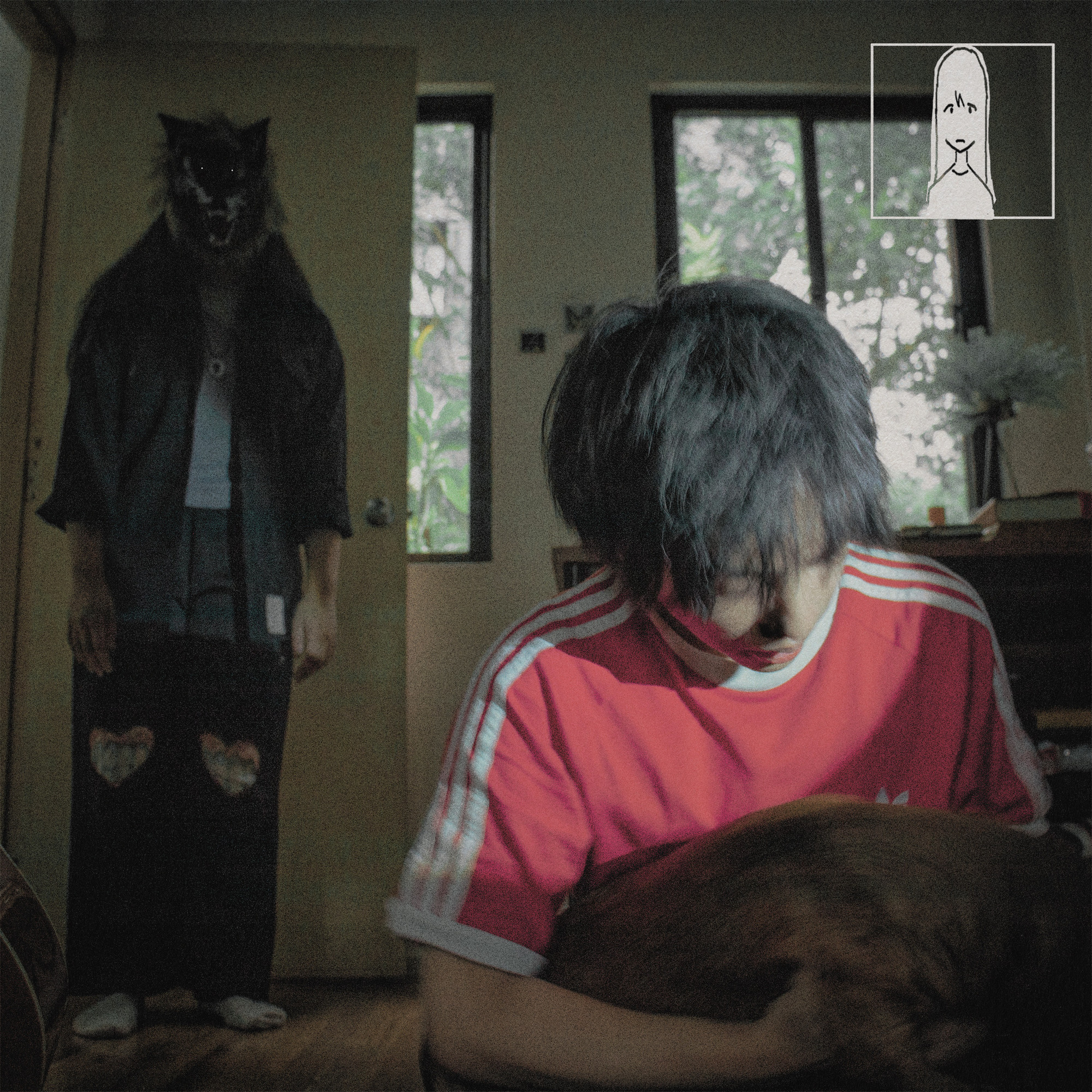
What do you get when you are in a dark bedroom, a Stratocaster, and being deep in the throes of melancholia? That’s what’s in store in muckmedicine’s newest EP “Caspian”. Spanning across 6 tracks are scattered thoughts and confessions left unsaid; a voice echoed through angsty indie rock. This EP is the second long-form release since Migs Tabilin’s debut EP “Inside Enclosures” back in 2020, and with this most recent project, he doubles down on his lo-fi sound. How muckmedicine differs from his sister band Fairview Far — which features more upbeat indie rock and playful lyrics — is that he takes the opportunity in his solo work to indulge in dejection.
With Tabilin’s solo work, he explores his melancholy and puts his inner monologue into song, using the audience as a stand-in for the person he wishes to let into his psyche. It’s intimate lyrically, which is only accentuated by the lo-fi vibe that Tabilin has embraced wholeheartedly. “Warmth” and “Erase Me (I Hope She Listens to Modern Baseball)” feature lyrics directed to a once-loved one. As a listener, it’s akin to reading a letter addressed to someone else, and what’s found in those letters is pining and unreciprocated love. The songwriting varies on other tracks, reading more like vignettes of thought. Scattered ideas similar to ones that intrusively pop up in your head while trying to go to sleep. This is seen in songs like “Please Play Florist At My Funeral” and the intro “Pattern,” which features a monologue from Ice King of Adventure Time. It adds to the DIY aesthetic, harkoning to tiktoks where people put midwest emo riffs on top of random monologues from cartoons.
True devastation is found in the combination of the two writing styles, which is no better showcased in the final track “Cut”. The song takes an even more sullen turn than the previous entries of the EP. It’s an unresolved goodbye led with resentment, and conversely, longing for what still could be. The abrupt and straightforward lines slice deep into the chest: “I don’t ever wanna see your fucking face again, I never wanted to see any of you again”. But the knife finds more purchase with the last line of the EP: “I never made a gesture, but I wanted you to stay”.
The production of the project lends a lot to the intimacy of the overall sound; The lo-fi bedroom rock sound only adds charm to the EP, further emphasizing the vibe of being alone in your room with only your thoughts to keep you company. The vocals are, at times, passed through an EQ filter, reminiscent of hearing a voicemail left late at night, as seen in “Wednesday”. The crunchy distortion of the guitars adds depth to the morose nature of the music and adds to the swell of the breakdowns in tracks like “Patterns” and “Cut”. The sound is evocative of the pandemic-era boom of home music production. When before it was a necessity, muckmedicine uses it as a tool to capture solitude and isolation, both physical and mental.
“Caspian” was an opportunity to say the things folks would never think to say out loud. To finally release the cacophony of thoughts and find closure in the music. The dedication on muckmedicine’s Bandcamp simply states “for our loved ones”, which could not be a more succinct description for the project. It’s an EP for victims of unrequited love and those who struggle to put into words the complex emotions they feel. Muckmedicine’s pandemic era sound was utilised beautifully in this project. As fitting as it was with the themes of isolation of the EP, it does leave the listener wondering if he’ll evolve his sound further in future projects. His style has been consistent to the point of stagnant with this EP sharing a lot of similarities from his initial EP which was released all the way back in 2020. 5 years later, it can be hard to tell if any time has passed at all. Knowing this, it just makes us even more eager to see what muckmedicine can come up with in his next endeavors.
Singaporean musician Jared Lim has been playing a significant role in various mainstay acts over the past couple of years, whether in his local country or elsewhere. Being the guitarist and producer of bands like Sobs and Subsonic Eye, as well as providing production assistance for Blush and The Purest Blue are just some of those notable credits. His ear for production sticks in your ear once you hear it: blissful synth chops, colorful instrumental mixes, and crisp vocal emphasis. A balancing act of sharp melodies and sparkling textures that are never put out of scale. An ability that only comes from very skilled producers who know how to leverage the mix without disruption.
At some point, if he can help produce these songs for these bands, certainly, he can write songs for himself, too. Soon enough, that is what he just did. Donning the solo project Jorud, he pulled together his debut album, aptly titled ‘The Song’. This is Jared Lim expressing the colors that he has brushed over before, now splattered on a sonic canvas that is his own. Whether that be the saturated 80s ambiance on “Am”, speedy waves of breakbeats on “Harm”, chilled out dance beats on “Wannastop”, or the chiptune accents across surfing guitars on “Have It”. He has these soundscapes all layered out.
Of course, it is not just him who gets the play around in these songs. Pauline Rana of The Purest Blue, Cayenne of Sobs, and elo elo provide contributing vocals in most of the album, filling the prismatic space with their friendly presence. Creating this slice-of-life feel where wholesome connections create more smiles along the way—shining the brightest on the title track’s sunny indie pop, “Friend” with its coat of shimmery hyperpop, and the raving, glitchy EDM of “Wideview”.
The word “joyous” is the best way to describe what Jorud has put together with his debut album. A brisk walk in the park is remembered most due to the unabashed display of melodies and textures that are overall jubilant and vivid. These might be just a collection of songs, but once you hear them, you can’t help but turn your frowny days into smiley days.
*The interview is edited with brevity and clarity:
LP: When I hear your artist name, Jorud, I imagine someone who’s chill and lively. What was circulating in your head when you were figuring out the identity of your solo project?
Lim: Actually, this project is kind of the first real music project I ever did when I was 15. I picked a stupid name that I don’t want to change, because I have all the URLs on Bandcamp and SoundCloud or whatever. It started when I was 15, [I was] learning how to use Ableton, and [was] just putting out stuff that I made on SoundCloud. Yeah, [there’s] not much thought to it, but I guess now, it’s been 10 years. So, I just felt like, “Uh, I should kind of do this properly.” See how it feels like to make an album and put it out properly and promote it and stuff like that. Yeah.
LP: You mentioned that you were using Ableton at the age of 15. What invited you to do production work during those times?
Lim: Before I started making my own stuff, I was making chiptune covers of songs. I’ll put them on YouTube. I did a few like CHRVCHES [covers], you know the band CHRVCHES?
LP: Yes!
Lim: Yeah, I did a few chiptune remixes of their songs, and they posted one of them on their Facebook. I was like 14, I was freaking out. Yeah, that’s kind of how it started. I was just making covers for fun, and then it led to making my own stuff.
LP: How long have you been conceptualizing and working on your debut project?
Lim: Some of the songs on it actually started quite a while ago, maybe like a year or two ago. But I didn’t properly think I was making something until, I think, it was December last year. I had the idea to send this instrumental track that I made three years ago to Pauline from [The Purest Blue]. I had that instrumental on my laptop for a few years and didn’t really know what to do with it until I had a sudden spark of inspiration. I decided to send it to her because I thought she would do something cool, and she did. That was December last year, and then from then on, I spent maybe three months combing through old ideas and making new stuff, and I just turned it into an album.
LP:Speaking about those collaborations with Cayenne, Pauline, and Elo Elo. Did you have them in mind while creating the album, or were they a last-minute afterthought?
Lim: [It’s] kind of a bit of both because, honestly, this whole album was like a last-minute afterthought. I made everything really quickly, but I always had those specific vocalists in mind for each song. The song with Elo Elo that actually just came out today [July 10, 2025], [it] originally was a remix I did for fun for this band that I’m working with. And that was more than a year ago. But I liked it too much that I wanted to keep it for myself. And Hui Jun (Elo Elo) heard that remix quite a while ago, and she said she liked it. So when I started working on the album, I was like, “Oh I should reuse that and I’m gonna ask her to sing on it”, and she did.
LP: You said that, for three months, you tried to quickly comb through your ideas for this album. During that process, were you inclined to listen to music a lot, or did you just completely lock in on what you had in mind and never listen to anything that might disrupt those ideas?
Lim: I feel like, generally, just in everyday life, I don’t listen to that much music. For me, my music listening pretty much only happens on a commute. So if I’m not going out [or] if I’m just at home. I’m watching YouTube videos, or working on my own stuff, and listening to my own music, I guess. I don’t really think there was a difference in that time period. I was definitely listening to some things that were inspiring me for specific tracks. But I think in general, when I’m working on something, I’m pretty locked in. I tend to just listen to [what] I’m working on, and when I’m about to go to bed, I export the files, send them to my phone, and listen to it while I’m falling asleep. If I have ideas, I’ll wake back up and work on it again. So yeah, I guess your description was kind of accurate.
LP: Speaking about some of those inspirations, there’s an array of sounds that you’re doing on this debut album. What were some of those sounds that you’re trying to emulate and explore?
Lim: [For] the tracks on the album, there’s 50% guitar indie rock stuff, and then 50% is just like straight-up electronic. I pull from the same inspirations that I have been thinking about with my other projects and stuff. Alvvays, Ivy, AG Cook, of course. This band from France called Tape Worms. Big inspiration. And especially for the guitar songs, I’m also always thinking about my friends’ work and bands like Curb, Carpet Golf, and Subsonic Eye. Seeing what my friends are doing and the kind of instrumentation and things like that. It’s always inspiring to me.
LP: Because you mentioned there’s a lot of music that is 50% guitar and 50% electronic. There’s this observation I have with Rock artists toying with electronica as of recently. Is that the current case for you? Or have you always been embracing rock and electronica for quite some time?
Lim: With my solo stuff, I’ve always tried to make not really like electronic music but electronic music with guitars. That’s always what I’ve been trying to do with my solo stuff, not so much with my other projects, but I feel like with Sobs we’ve lately been trying to do that, combining both things because that’s what we enjoy.
I think it’s also just a circumstance of making stuff by myself at home on my laptop; it’s just easy to make electronic music anywhere on any computer. And the only other tool I have is my guitar and my audio interface, so it kind of made sense to try to do something that feels like both.
LP: Because you basically have those tools for that kind of music.
Lim: Yeah.
LP: How does being in solitude help you out in terms of producing for other acts?
Lim: I think this is a common thing, but I think I do my best work when I’m alone on my headphones with no one around me to hear it hahaha. That’s how I usually mix and arrange for any project I’m in. With Sobs, it’s really just us by ourselves at home working on our individual parts over the internet, so I’m just very used to that workflow. [It] doesn’t help that I get super anxious and second-guess any of my creative decisions when other people are around – I think all this might hinder rather than help me, but it’s worked out so far.
LP: Whenever you play around with your instruments and software, how do you decipher which songs belong to you or to other projects?
Lim: Actually, the title track the one that pauline sings on, I made that track just the instrumental three years ago, thinking that it would be a Sobs song just because at the time it has that same idea of guitar pop, this is what we want to do but it just sat on everyone’s laptops for a while so it didn’t get worked on, so I just decided [that] I’m taking this, I like it too much. If you’re not going to use it, mine! This is like a strange question for me also, because this is the first time I’m intentionally working on solo music and like making stuff with the intention of putting out under my own name. So it’s new to me too.
LP: Once you have the time to listen to music, how does the process make you feel or replicate the sounds that you hear?
Lim: I think there’s always [a] subconscious influence on anything that I do from the music I listen to, but when I’m actively working on it, I try not to think about artists that I like or songs that I like. I’m just sitting down in front of the computer, and I’m making it exactly how I hear it in my head. This is what I want to make right now. There’s definitely influence from everything that I like but when I’m making it, I’m just thinking of how I want it to sound, like how I imagine it in my head. I don’t know if this is a bit cringe, but when I’m working on something right now and I need to go out later, then I’ll listen to the song that I’m working on loop on the way to the thing that I have to go to.
LP: What are some emotions that flow immediately to you once you start wearing your producer hat, especially for this album?
Lim: So, if I’m working on a song for Sobs, I’m thinking about live band arrangements and how we’re gonna play this song live. Trying to make it easily translatable to a live show. I don’t think about that all the time, but it’s in my head. But when I was working on this stuff, I wasn’t making stuff with the intention of anyone else hearing it live or even hearing it in general. I’m just throwing ideas onto the board wherever I can. Literally just whatever idea I have, I’m gonna put it in until it’s a mess. And if I don’t like some stuff, then I’ll take it out. That was the mindset I had going through it.
LP: Do you have a certain plan on performing these songs in a live setting one day? Or is it the kind of project that you’re just gonna keep to yourself in the studio?
Lim: Yeah, I think. I mean, I have done DJ sets and things like that. But, yeah, I think the stuff on this album, apart from the really dancey ones that I can just play at the DJ set, I don’t think I’ll ever do any live thing. I’m not saying never, but it’s not something I think about. Honestly, I was almost just gonna put this all out on SoundCloud and call it a day. But something in me decided to promote it for real. Yeah, I wasn’t thinking about playing. I’m freaked out about that, being by myself.
LP: Unless, Cayenne, Pauline Rana, or Elo Elo are there for the specific songs, right?
Lim: Yeah, yeah.
LP: What track from ‘The Song’ album was most satisfying to complete? Which one of those songs is the toughest to finish?
Lim: I think, Lucky, the eighth track. That song went through quite a long process of the initial demo to where it is now. And I’m really happy with it. Basically, I was working on the title track with Pauline and I was telling her, “I think I’m making an album. I have a bunch of songs.” I sent her a bunch and she really liked this one track that was really unfinished. It was just guitar and drums, and she kind of unprompted, sang stuff for it. And I was like, yes! Her vocals on that song really helped me decide where it needed to go and what it was gonna sound like. When I finished that one, I was like, “Yeah, wow. This rocks.”
LP: It really does, it really does. But back when forums were still a thing, Singapore also had its own music forum called SOFT. What were some of your core memories with that forum?
Lim: Uh, it’s actually still around. I don’t know if it’s really active, but people still go on there to sell gear and stuff. My earliest memory of SOFT was helping my dad sell an old bass guitar that he had. I put up the forum post and everything. Took the photos, uploaded them on Photo Bucket, if you remember Photo Bucket. Yeah, that’s my earliest memory of soft.com.sg. It was doing that. I occasionally still look at the classifieds on there. Cause sometimes there’s stuff that people don’t post on Carousel or stuff like that. All of my first bands growing up [met there]. When I was in school, we’d find each other on SOFT. That’s how I met Celine from sobs. Special website. Awesome website.
LP: Really special one.
Lim: Old internet.
LP: Old internet days, yeah.In your experience, now that you’ve been active within the Singaporean music scene, what’s the special thing you hold dear there?
Lim: I feel like there aren’t that many things that are unique to the specific place that we’re in. But I think it helps that Singapore is so small, and the community of people making music is even smaller than that. So, it’s a lot easier to find the people who make stuff that you align with.
I feel like I’ve been lucky over the years. Joining Subsonic Eye was kind of the start of my whole thing. Meeting a lot of people. People who make similar music and vibe with the same stuff. That’s what I cherish, people around us who are making cool stuff, and I don’t think that’s unique to Singapore. It just helps that it’s such a small scene in a small country. Right now, I think there are, like, three venues.
LP: So, it’s really tightly knit, tightly connected to each other.
Lim: I would say so. Every genre has its group of people. But everyone tends to know each other and hang out at the same places and play shows on the same lineup. That’s what I like about being a musician in Singapore. It’s small, and you can fairly easily find the people who would connect with the things that you do.
LP: What was it with electronic music in general that has captivated so many artists in Singapore?
Lim: This may not be true, but I think it’s also because there’s so little physical space. It’s not like you can form a band and practice in your basement or your garage. Everyone lives in tiny apartments, and it’s pretty easy now to go on YouTube and find a tutorial on how to use the FL Studio or something. I think maybe that might have something to do with it. It’s just that, we are cooped up in our homes.I might not be the best person to ask that because I’m not super familiar with the electronic music scene. Like, I don’t DJ a lot, but I know it’s a thriving thing right now. There are a lot of raves and events and stuff going on. I’m not super tapped in, but there’s a lot of cool stuff happening right now. There’s this collective called Scum Boys. They have a bunch of producers making cool stuff. I think, if you have a laptop, if you have a computer, you can make it. You can just figure it out. And that’s the best part of it. Anyone can do it.
LP: Since this will be the first time that you are releasing your album, what does it say about your identity now that you’re able to have your own voice within the Singaporean music scene?
Lim: I approached this project in a similar way that I approach any other work I’ve done with mixing and producing other artists, so I’d like to think it just reflects what I’m able to provide to others. But I guess I’m also leaning on my direct instinct with the solo stuff in ways that I can’t usually do when working on other projects.
I tend not to think about “the scene” when making stuff because really I’m just used to finishing tracks and immediately uploading them on Soundcloud without the intention of like more than 5 people hearing it. It’s been a weird process putting stuff out under my own name and promoting it, doing the whole rollout schtick when I’m usually so averse to it because I like having people hear my stuff, but I’m still so self-conscious about it. I just try not to think about those things, like my place in the community or whatever
More than anything, I’m glad to have this opportunity to spotlight musicians from other scenes like Pauline and peers like Elo Elo and Cayenne, I feel like it’s just me wanting to make stuff with these people for fun.
LP: Do you consider yourself to be meticulous, or do you let spontaneous ideas carve your work process?
Lim: I think, while I’m making stuff, coming up with ideas and things like that, I’m not super precious about it. I’m just thinking of ideas and putting them down as soon as I can before I forget them. But, when it comes to producing. After the initial idea is done, I’ll get kind of into it.
Cause over the years I’ve been mixing other people’s music and learning a lot of things from doing that. So, when I’m coming back to my own stuff, I’ll get pretty into it, but I wouldn’t say I’m a perfectionist. I just want to get what I imagine in my head. I want to make the song sound like how I imagine it, too. And once I’m close enough, then it’s done. But then again, with other projects that I’ve worked on, I’ll think it’s great [at first]. And then a year later, I’ll listen to it, and [be] like: “fuck, I should have made the kick louder or something.” It’s always like that. But, yeah, I think when I’m in the moment, I tend not to be so particular about that kind of stuff.
LP: If there is a specific sound trend from the past that you want to see get more attention today, what would it be?
Lim: Hmm. Specific sound. I would like to see MIDI strings come back. Just like a long-held midi string note. That’s it. Just one note. Pan a bit to the left. That’s what I want to hear in every genre. Just Midi strings. One note. Weeeee! That’s what I want.
Every artist starts out as a fan. You get exposed to all the ways people express themselves and enjoy it so much that you’d want to take a shot at it yourself. So just as the name “Your #1 Fan” suggests, Nica Feliciano started out living and breathing music – frequenting gigs in the underground music scene; playing bass guitar for bands such as Bird Dens, Thirds, and The Purest Blue; and even putting up her own indie rock shows. It was inevitable that Your #1 Fan would eventually be expanded into a music project; that time has come with the release of her debut single, “Radio Transmission.”
The wonder and curiosity of being a fan is manifested in the music and lyrical themes of this song, a space rock ballad that sails like a probe traversing the cosmos. But the story remains mostly within the Earth’s atmosphere: here, Nica longs to make contact with somebody she loves who’s in another part of the world, wanting to know whether there’s a place for her in their heart even though they’re so far apart. The imagery of satellite communication courses through these lyrics, as it does in the music, with beeps and pulses that sound like incoming signals peppered throughout the song, which plays at a tempo meant to relive the grandeur of space travel.
However, the song picks up speed halfway through as Nica begins to blur the boundaries between the vast distance of two lovers on opposite sides of the Earth and our collective smallness within the universe. It no longer matters that life means we’re all tiny figures tethered to an ultimately tiny place: as long as she makes contact with the one she loves, the concept of dimensions just fades away.
Whenever we define ourselves with the celestial bodies, we often look to the Moon and its chase towards the Sun, or our relation with the stars, or even the depth of the unknown. Therefore, to hear an exploration on the celestial bodies we ourselves have created, and how we used our discoveries of outer space to bring us closer to one another no matter where we are in the world, is refreshing for once.
Which brings us back to the cyclical nature of the making of an artist: we take what we find in the artists that we love and make something from that for ourselves. With “Radio Transmission,” Your #1 Fan has successfully taken that one small step as an artist, and as Nica continues to release more music and plays more shows with this project, people can certainly look forward to the great leaps ahead.
Who knows? You could become Your #1 Fan’s no. 1 fan.
Filipino production house FlipMusic is known for being the genius behind some of the hottest OPM tunes, may it be Ron Henley and Pow Chavez’s bouncy rap song “Biglang Liko,” or even Nica del Rosario’s politically motivated serenade “Rosas.” In this current era that’s experiencing an influx of Pinoy Pop groups debuting left and right, from the easygoing AJAA to the versatile KAIA, it’s no surprise that FlipMusic has played a part in steering the direction of P-Pop’s sound. They’ve gained plenty of praise for mastering the recipe of bubblegum pop–after all, they are the masterminds behind some of BINI’s most beloved hits, such as “Pantropiko” and “Salamin, Salamin.” Taking a step further in pushing P-Pop to greater heights, FlipMusic debuted its own girl group, VVINK, with the release of their debut single, “Tulala,” on July 10.
It’s evident that P-Pop is influenced by the sounds of the Hallyu Wave, and FlipMusic skillfully takes from K-Pop’s “a little bit of this, a little bit of that” approach, where the music acts as an auditory stage. It’s a playing field that focuses on showcasing the idols’ learned prowess, honed by their dedication to training. In the three minutes and 26 seconds of the song, its simple yet carefully constructed structure showcases the talent and charisma possessed by the five girls of VVINK. The synths that open the song catch your attention, pulsing and full of energy, matching the explosive vocals of the members. What about a bouncy rap part immediately greeting you in the second verse? An impactful bass drop for a dance break? Truly, VVINK makes the most out of “Tulala’s” runtime, sonically putting out all of their strengths for the budding fan to admire.
Make no mistake, despite the different ways “Tulala” pulls from its many influences, it is purely and thoroughly P-Pop, from start to finish. In the various ways the girls project their voices, you can’t help but hear the bubblegum pop roots that were planted over a decade ago. They’re a little coy, a little sincere, and a little fierce, carrying the torch passed onto them by the discographies of artists like Nadine Lustre and Donnalyn Bartolome. With an addictive bassline and a mesmerizing guitar solo added into the mix, FlipMusic’s extensive understanding of pop music truly shows.
Of course, VVINK covers all the bases. “Tulala” also bears the standard pop music cheesiness of its ancestors–the way its lyrics fall off the girls’ tongues makes it an easy earworm. “Ano ba ‘tong ang diyahe?” They sing with earnestness, followed by their collective “OMG” in the background, full of life and ‘kilig.’ They even came prepared with word play: “If I’m your lady, I’ll go ga-ga, your baby goo-goo, ga-ga.” From the onomatopoeias to the expressions of a pounding heart, VVINK recalls the feeling of having a schoolgirl crush with ease.
Understanding what makes pop music pop is a skill, and FlipMusic’s capability to do so has granted them the ability to make music that captivates the ears of Filipinos all over the nation. It’s exciting to see the places VVINK will go and how their talents will help in shaping the sonic landscape of P-Pop.
After a feature in Fax Gang and Parannoul’s collaborative album, and an appearance in Sining Shelter’s 2024 compilation tunes for a true home, Texas-based agatka’s sophomore album Black Spring arrives in the wake of what can be described as a tumultuous time for the artist.
Presented as a “true documentary of all the things I’ve felt in the past year and a half” by agatka, Black Spring is a pulverizing blood rush straight to the dome when considered in its entirety. Across each track, the project warps in different tonal and sonic shifts and constantly dips itself into abrasion balanced out by tracks that allow you to catch your breath. “PISTOL ROUND,” “ROLL THE DICE, I LOSE AGAIN,” and “DOORDASH THERAPY” (in what appears to be in the same arrangement heard in tunes for a true home) barge in guns ablazing, simmer down, then pick up again at five tracks down; trap 808s, beheaded producer tags, Vocaloid sample flips, gutteral echoes, and high-energy grooves, deftly find their respective places in the album, alongside its shoutouts including Fax Gang, Andy Milonakis, and Counter Strike. In this regard, agatka falls in line alongside their contemporaries in placemaking their discography with internet artifacts, which serve as not just sonic decoration but also as referential material for the extremely online.
Not only that, but framed within America’s sociopolitical landscape, Black Spring is also a direct response to and a first-person observation of America’s many failings, especially under its current administration, from a first-generation Filipino immigrant. “I FEEL FANTASTIC” depicts scenarios of violence against the far-right and a distrust of the system at play.
Stitched by its commitment to verisimilitude, agatka has created a body of work that not only appears coherent in its accumulation of unapologetic angst and trauma across the span of it being produced, but condenses it into a vision that lands. I find myself returning to a number of tracks after initial full album listens: “CAMERON COUNTY COWBOYZ” emerges as a standout in its juxtaposition; wrapped around a silky smooth sample, stream-of-consciousness confessional lyrics end in a crescendo that pierces right through: “I can’t let go / I haunt myself / just like a ghost.” Meanwhile, “LORD FORGIVE ME” and its ruminations on existential and spiritual crises are on top of a thumping club rhythm, which comes across as catharsis in its three-minute runtime.
Beyond these categorizations, Black Spring emerges as a body of work that could stand beyond its fixation on the present. Recorded across different locations in the United States over almost a year, the fifteen-track album comes across as an assemblage of raw moods and textures that carry the weight of its lyrics from the moment it was written down, distilled into a form that persists as something almost universal. Almost all of the lyrics of each track are written in the present tense, creating a sense of immediacy that, when addled with heavy production or laid bare, transports you to the same room where each track is made. Political statements and world-weary confessionals are rendered in the same way; one that can be seen as both tactile and tactless.
Devoid of any need for metaphors, agatka’s “BLACK SPRING” serves as a teller of their own unfiltered truths.
After releasing her debut EP Gabi ng Lagim in 2024, K follows up with her first collaboration, “Dilim,” a single featuring LORY. In the track, what emerges is less a duet and more a convergence; two voices moving through the same storm, not hand in hand, but aware of each other’s shadows. The track doesn’t open the door gently; it surges into the room. From the first downstroke, its intent is not to be misunderstood, but rather, to dislodge, to engulf, and to hum beneath the flesh like a second skin.
“Dilim” feels like reading a letter written in a language you once knew, every line familiar but just out of reach, each word flickering at the edge of meaning. The guitars churn like static caught between radio frequencies, and the drums tick forward with the cold precision of a dying clock. K doesn’t sing, she pries sound out of her sternum, each note arriving cracked, as if it’s already lived through the pain it’s meant to express. LORY, whispered but no less real, dances upon the spaces between, like smoke tracing the lines in a windowpane.
The track is not linear; it sways, it plunges, it crests in unsymmetrical waves. There is a studied vagueness to it, as though the track had been constructed underwater, under silt and memory. Emotion rises like steam, hot and ephemeral, but the form never coagulates. It’s a song more sensed than taped; held together by mood, not motion.
There’s beauty in that blur, and restlessness. The weight is there, yes, but where is it? The track hangs on without completely falling apart. Despite all its weight, there’s a feeling of something withheld, not due to mystery, but restraint. A tremor that doesn’t end in collision.
But to define “Dilim” in what it does not have would be inaccurate. There is clarity in its ambiguity, there is comfort as well. Something does not always have to come in whole or in its entirety. Some music is scaffolding; empty frameworks where people superimpose their own ruin, their own fixing. “Dilim” does that. It does not thrust sorrow onto the stage, but offers it. It doesn’t demand anything of its listeners, but allows for them to make the song their own, whichever shape it morphs into, depending on its beholder.
And perhaps that is its goal; not to enlighten, but to resonate. Not to answer, but to ring true. The sort of song that doesn’t speak at you but to you.
Alt-fusion Wuji Wuji has always been a six-piece defined by motion. Their sonic palette constantly twists, turns, unravels like a loose thread, and is always in flux. From jazz-funk rhythms to the dreamy allure of city-pop, now they’ve peeled it all back, exposing ”NOVISION,” a six-track extended play hot out of the oven: fresh, with a warm, experimental bite.
This sophomore release is a deliberate act of destruction and reconstruction, preserving some past elements but shedding the hip-hop influences entirely from “NOSOUL.” Drenched in brooding basslines and reverb-heavy guitar, “Times a Crime” and “Push & Pull” carve the emotional core of the EP. The title track “NOVISION” is to surrender to zero gravity, lost in the space of vocal layers and synths that hum like a distant past. It projects exactly what it needs to: a sense of suspension before the EP concludes, acting as a transition to the second half. “Careless” and “Words Hurt” leave things taut, not unresolved. These tracks lay a pivotal point in the EP, deliberately placing the listener in a state of emotional inertia and reflecting a measured evolution in Wuji Wuji’s sound.
“NOVISION” was created during a period of identity struggle for Wuji Wuji, a bold, risky move that marks a turning point in their discography, defying expectations that they would lean further into the city-pop path laid out by 2023’s “Kanluran.” But that shift isn’t a misstep; Instead, it reflects their growing curiosity in production and willingness to explore unfamiliar territory.
Wuji Wuji doesn’t just change direction; they embrace uncertainty as part of the process. Whether this marks a sound caught mid-metamorphosis or a new era, “NOVISION” proves that the group admires movement more than comfort, and that’s exactly what makes them worth following.
Founded in 2022 by Sam Slater, Italy Jones, Aron Farkas, and Jack Von Bloeker in Mission Viejo, California, five-piece skramz band Clay Birds is onto their sophomore EP, a separation of vanity, a palimpsest which gleams with dissonance and introspection, intimate as it is liberating.
separation of vanity begins with “an intuition of morality”, a track that immediately sets you into a dirty basement, sweat flying from slamming bodies of a mosh pit, the heaviness of stomping feet on broken floorboards. The song carries a weathered subtlety, like a memory half-sung on a battered Telecaster; its bitter, wistful texture echoing the kind of late-night conversation you’d only dare to have beneath a spray-painted-over bridge, when it’s too dark to see each other’s faces but too honest to look away.
As the EP progresses, Clay Birds’ sound is revealed not in nuance but in imperfection, sharp energy that’s like being pushed off a bike or your heart racing through the seams of a t-shirt. Every song is peeling away, a slash into the emotional undertow of being young.
The tracks pose as an unraveling, taking you through the architecture of what has come undone. Each song arrives unearthed, dismantled, plunging you into its entropy.
The music doesn’t come out as complete or polished. Rather, it seeps through, and invites people to bask in the mess through the acceptance of being unfinished together. What you hear is reminiscent of cut-short and picked-up conversations from venues, voice calls, and basement shows. It’s built with the rigid kind of faith that only exists between people who’ve gone through the same pain and somehow ended up at the show. Spoken in glances and gestures, in the nods around a circle pit, in the soothing silence when the set ends, it’s a project that insists: you’re not alone.
These are not songs sung over a crowd but with them, music which depends on the listener’s openness to feel, to shatter, to mend in tandem. There’s a very real sense of every single line having been written in a room full of friends screaming the same thing at once, each of them taking the words because they’d written them themselves. The EP is not simply a recording of hardship; it’s a recording of being close enough to another person’s agony that it becomes your own. It’s not catharsis by distance but radical empathy.
Even with its rough-around-the-edges demeanor, this is hardly a “noise” EP as you might anticipate. The language itself is the heft in this case, pulling on you instead of shoving away, evoking the spirit of unity.
This culture of sharedness is at the center of the band. On their Bandcamp, there is a short sentence that reads: “Birds of the same feather flock together.” It’s a slogan, naturally, but something more. It reads as if it’s a manifesto. Clay Birds traces back to a more wide-ranging Gen Z DIY skramz ecosystem where communality is at the backbone of everything. Whether it’s through collaboration or collective effort, it’s in these relationships that the scene is rich, not competitive but cooperative. Pilfer their overlaps with bands like Composition Booklet and Kiowa, who the band shares members with. Not to mention their joint release with Knumears, where the sky meets you.
By the same token, there is their commitment to DIY. Take for example their 2022 cover of iwrotehaikusaboutcannibalisminyouryearbook. The clip is didactic in its austerity: a cymbal to which a microphone is duct-taped, an unadorned, visual paean to the spartan aesthetic that characterizes the scene. DIY in this instance isn’t about utility but about authenticity, about not sanding off what makes the music sincere.
Although considered one of the younger generations within the scene, Clay Birds continues a philosophy that has defined the scene for decades now: vulnerability, urgency, presence. It’s this devotion that brings their music back to haunt you long after the final note has disappeared, leaving not just sound, but the sense of something real, something felt behind. A band that challenges you to listen with more than your ears, but with whatever is still left of you that aches.
Their cries form not chaos but concord, a solemn pact that, despite everything, the kids are alright.
Why do I like it? Because it allows me to think out loud, and more importantly, do so alongside others. Not to be heard, but seen. Which reminds me — this is what life is all about.
A close look at Indonesia’s rich history reveals specific moments in its music deemed significant in the past. The Pop Kreatif scene in the 70s – 80s, the existence of bands and musicians like Koes Plus and Chrisye, and the distribution of bootleg tapes of foreign music that influenced so much of Indonesian music, are big examples of that. Despite the negative economic effects that came from the harsh political climate throughout the Old Order and New Order regimes as well as shaky record label deals that stifled the proper archival of older Indonesian music, the modern methods of compilations and online uploads of records and songs released in the 60s – 70s still gave them their spot to echo. Once a figment of the past, it is now slowly being brought to the present once more.
In the city of Surabaya, Indonesia – a home to significant names of the Indonesian music scene such as Ervinna and Dara Puspita – lies the band Thee Marloes, signed under the Big Crown Records label. Comprised of Natassya Sianturi (vocalist & keyboardist), Tommy Satwick (drummer), and Sinatrya “Raka” Dharaka (guitarist & producer), the members crossed paths through their passion for music, Natassya’s performances in local shows and Tommy and Sinatrya’s constant band & DJ pursuits have allowed their paths to meet. Natassya’s love for retro soul and pop has established what Thee Marloes will eventually become: classic soul with the city of Surabaya filling its identity.
‘Perak’, their debut album, becomes the band’s firm statement of who they are and what they bring to Indonesia’s musical landscape. Lush soul with scoops of jazz rhythms and pop hookiness, all tied by the fragments of love-driven stories that light up the streets of Surabaya’s cityscape. A combination of local and universal elements held together through warmly cushioned production and especially Natassya’s serene singing. Her voice deftly weaves across English and Malay, bringing such kindling flair to songs like ‘Over’ and ‘Nona’ where she soars around pretty backing vocals, and ‘True Love’ where she opts for an alluring voice that effectively pulls you into the song’s humid atmosphere.
But, of course, the band’s instrumental chemistry is also something to behold. Their flexibility allows more supple charm to be embossed in these compositions. Whether that be the shuffling rhythms shown off in the drum and bass rumbles of ‘Midnight Hotline’ and ‘I Know’, the psychedelic dazzle of ‘Logika’ coming through the organ sounding keys and simmering grooves, and the relaxing affirmation of ‘Not Today’ with the soulful layers of bright keys, simple drum patterns, and gentle guitars. Their melodic variations add more elegance, leaving more color to stew within the record.
The album title, when translated, means ‘silver’. An apt word for what Thee Marloes has displayed with their debut album thus far, approaching the spirit of the city of Sarubaya and the familiar beauty of soul and R&B with malleability, further shaping themselves in the process. ‘Perak’ only adds another page to Indonesia’s vibrant music history. A reminder of soul, disco, and funk music that once permeated their past, giving life for those genres to breathe with excitement today.
The interlude of “fool’s gold,” the latest EP from R&B singer-songwriter Jess Connelly, is a song that speaks of unconditional love. In under two minutes, she lays down creeds of a committed monogamy with somebody in spite of the vultures circling around them. The lyrics sung are the words we say to a lover when we know there is trust between the two of you, when acts of love need not be asked and feel like they just fall into place.
But putting it another way, these are the things we say to ourselves when we hold on to a stagnating relationship, when complacency sets in, and feelings turn lukewarm. Now you’re desperate to keep the relationship steady, but you know it’s not getting any better, what with the permeating silence and all the lit matches ready to catch a moth. The honeymoon is over, which is why it makes sense that Jess named this track “indelulude.”
This interlude is the turning point that bridges the two halves of a collection of songs in which Jess details the life cycle of a love that’s too good to be true: a rendezvous with a flame too thrilling to pass up on, too selfish to settle down with, but too powerful to forget. “fool’s gold” delivers this story upon a backdrop of class and elegance that we’ve come to expect from a Jess Connelly project, provided here by long-time collaborator LUSTBASS.
The moody atmosphere of the music and the greyscale cover art bring a noir feel to the EP, especially with the live instrumentation of the opening track “flow.” The sense of space brought by recording a live band, drawn particularly from the cymbal-heavy drumming, complements the feeling of wonder and excitement in wanting to get close to someone new, as though we see two people cozying up to each other at a bar. But it doesn’t take long for mischief to set in. On “fool me twice,” we find that this new person has wandering eyes, and we get a feeling that what the two have between them may not be as serious as she had hoped it to be. Nevertheless, she sticks around for a while, spellbound by a one-sided fling with somebody she couldn’t refuse.
But after this hallucination drifts in and out for the last time on “indelulude,” Jess has decided enough is enough. “never fall in love again” talks about the aftermath of this love affair, in which she makes it clear to her former lover that he will feel the absence of her unconditional love. But that doesn’t mean his absence hasn’t affected her either: after getting into a few rebounds, she reveals she might not be able to find true love just yet.
The final stage of grief is acceptance, and in the closing track “let the bird fly,” Jess confesses that the time she spent with this man was unforgettable. Over a jittery drum break, we see her rekindle things with him despite everything she learned about people like him throughout this EP. This is the part where the real delusions set in, where acceptance is taken as a chance to blindly start over with someone who will never change and has taught another to do the same.
Likewise, “fool’s gold,” in its intoxicating drama set to a warm, cozy score, is a project you will come back to again and again. Jess Connelly’s impeccable writing and composition, combined with LUSTBASS’s ear for space and instrumentation, have produced the perfect soundtrack to get you through a failed relationship, where you’re hung up on the things that could’ve been with someone you needed to get away from.
Which brings us to the waltz-like beat at the end of the EP. It goes on for a few bars until it abruptly stops, slowing down like a record no one wants to hear again. Did Jess break the cycle? Were the events in the last song just all in her head? We can only guess the answers to these questions because the story is over.